
There’s something oddly fascinating about asking what time was 3 hours ago. It sounds like one of those tiny questions you ask in passing, but then it quietly unfolds into something much bigger.
Maybe you’re checking when you sent a message, wondering when your bread actually went into the oven, or trying to remember whether you watched one more episode of Netflix than you promised yourself. Funny enough, time has a sneaky way of sliding past us without saying goodbye.
I remember once glancing at the clock, convinced I’d only been working for a little while. Then I looked again and realised nearly 3 hours ago I’d been making coffee instead of writing.
That tiny discovery felt weirdly loud. Time dosen’t always leave footprints, but it certainly leaves consequences.
Whether you’re looking for a quick time calculation, trying to improve time management, or simply satisfying your curiosity, understanding how to work backward by three hours is surprisingly useful.
This guide explores exactly that, while also looking at why those three hours often matter much more than we first imagine.
| Current Time | 3 Hours Ago |
|---|---|
| 6:00 AM | 3:00 AM |
| 9:00 AM | 6:00 AM |
| 12:00 PM | 9:00 AM |
| 3:00 PM | 12:00 PM |
| 6:00 PM | 3:00 PM |
| 9:00 PM | 6:00 PM |
| 12:00 AM | 9:00 PM (Previous Day) |
What Time Was 3 Hours Ago?
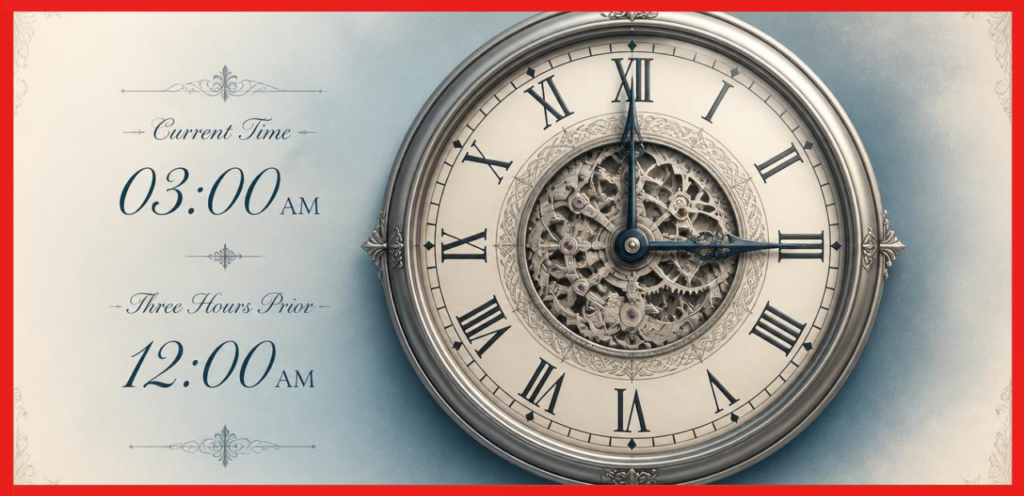
The simplest way to answer what time was 3 hours ago is to subtract 3 hours from the current time.
For example:
| Current Time | 3 Hours Ago |
|---|---|
| 6:00 AM | 3:00 AM |
| 9:00 AM | 6:00 AM |
| noon (12 PM) | 9:00 AM |
| 2:00 PM | 11:00 AM |
| 3 PM | 12:00 PM |
| 6:30 PM | 3:30 PM |
| 10:45 PM | 7:45 PM |
| 12:00 AM | 9:00 PM (previous day) |
The process sounds almost too easy, yet many people still double-check because our brains aren’t really built to do little bits of arithmetic under pressure.
A digital clock shows the answer instantly once you think backwards, while an analog clock sometimes makes the idea feel even more visual.
This simple time subtraction gives you the previous time, the exact clock time, and the correct time difference.
Why People Search “What Time Was 3 Hours Ago”
People rarely ask this question just because they enjoy numbers. Usually there’s a story hiding behind it.
Perhaps your manager asked when you logged into your computer, and you’re checking an activity log. Maybe you’re wondering whether that expired yogurt sitting inside the refrigerator was left out for too long.
Sometimes you’re planning medication, reviewing a workout, checking a delivery, or remembering when guests arrived at a dinner party.
The question what time was 3 hours ago from now also appears frequently when people review meetings, calculate travel times, or update a diary after a busy day. Life leaves little timestamps everywhere, even when we don’t notice em.
How to Calculate 3 Hours Ago Correctly
Calculating three hours earlier follows one simple rule:
- Look at your current hour
- Subtract 3 hours
- Adjust the day if you pass midnight
- Keep the minutes exactly the same
Examples:
- 8:20 PM becomes 5:20 PM
- 1:15 AM becomes 10:15 PM yesterday
- 12:40 PM becomes 9:40 AM
That’s all there is to it.
If you’re asking how to calculate 3 hours ago, this method works every single time regardless of whether you’re using a phone, wall clock, smartwatch, or manual calculation.
What Time Was 3 Hours Ago: Everyday Situations Where It Helps
The phrase what time was 3 hours ago pops up in everyday life much more often than most people realise.
Imagine you started a creative project this afternoon. You became completely absorbed, ignored your phone, skipped your snack, and suddenly noticed daylight disappearing.
Looking back exactly three hours helps estimate how long you’ve been working without needing sophisticated time tracking software.
Parents often use it when checking feeding schedules.
Drivers use it to estimate departure times.
Students calculate study sessions.
Office workers compare login records from StaffWatcher or other workplace monitoring systems.
Even people browsing Reddit sometimes ask similar questions while discussing schedules, productivity experiments, or timezone confusion.
Three hours can disappear surprisingly fast, cant it?
Understanding Time Difference and Elapsed Time
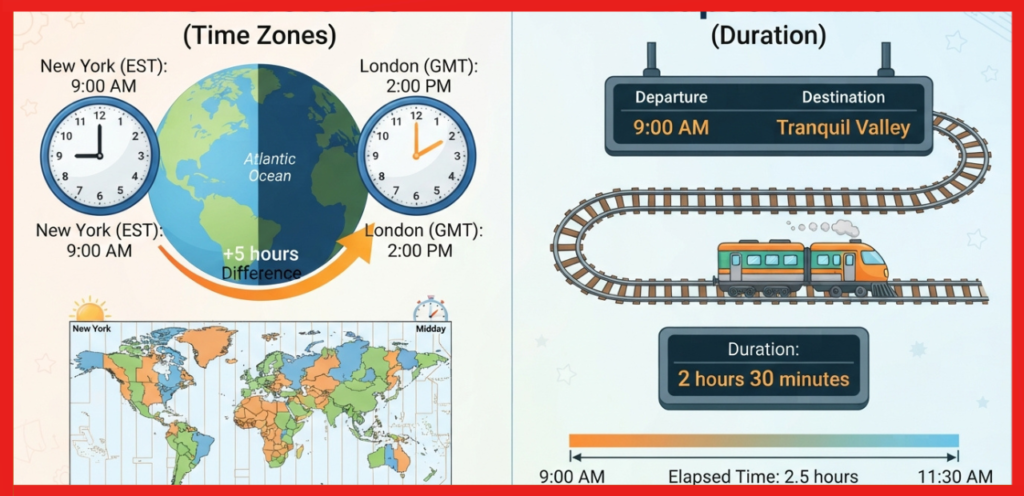
The concept of elapsed time is central to understanding past moments.
Instead of asking “What time is it?” you’re asking:
“What was the past time?”
That small shift changes everything.
When calculating a time interval, you’re measuring the gap between two events rather than identifying one fixed moment.
Examples include:
- Exercise duration
- Cooking time
- Study sessions
- Flight departures
- Meeting schedules
- Rest breaks
Knowing the time difference improves planning because every completed activity becomes easier to evaluate.
What Time Was 3 Hours Ago for Better Productivity
Oddly enough, this simple question can improve productivity.
Instead of asking where your day went, ask yourself:
“What was I doing exactly three hours ago?”
That tiny question often reveals patterns.
Maybe you spent three hours scrolling TikTok.
Maybe you finished important work.
Maybe you switched between tabs on your computer fifty-seven times before writing one paragraph. Happens more than we’d like to admit.
Looking backward encourages honest reflection rather than guesswork.
Using Time Reflection for Self-Assessment
Regular self-assessment isn’t always about performance reviews.
Sometimes it’s simply remembering.
Ask yourself:
- Where was I?
- What task was I doing?
- Was I focused?
- Was I distracted?
- Did I move closer to my goals?
These questions transform a simple time lookup into meaningful reflective thinking.
A personal daily journal or diary becomes much richer when paired with small time references.
Daily Routine and Activity Tracking
Many successful people quietly perform activity tracking without even calling it that.
They notice:
- When they wake up
- When they eat
- When they work
- When they rest
Tracking daily routine creates awareness.
Imagine checking your planner and realising that three hours before now you intended to exercise but somehow ended up reorganising desktop folders instead. Tiny observations like this improve habit tracking more than grand motivational speeches ever could.
Time Management Starts With Awareness

Effective time management isn’t squeezing more work into fewer hours.
It’s understanding where hours actually go.
The question what was the time 3 hours ago reminds us that every hour already belongs somewhere.
Without awareness, busy work quietly replaces productive work.
That’s where planning, task organization, and prioritization begin making a difference.
Planning Ahead Using Time Calculations
Good planning isn’t predicting the future.
It’s understanding the past well enough to improve tomorrow.
When you regularly calculate time, you become better at estimating:
- Project length
- Break duration
- Travel time
- Reading sessions
- Cooking schedules
Eventually your internal hours calculator becomes surprisingly accurate.
That’s one reason professionals often rely on both a time calculator and practical experience.
Productivity Techniques That Actually Help
Many people combine time awareness with structured systems.
Popular methods include:
- Pomodoro Technique
- Pomodoro timer
- time blocking
- Calendar scheduling
- Focus sessions
These approaches encourage focus techniques, stronger work efficiency, and healthier work-life balance.
Rather than guessing where time disappeared, you actively decide where the next few hours should go.
What Time Was 3 Hours Ago and Goal Setting
Looking backward also strengthens goal setting.
Suppose your long-term ambition is writing a book.
Ask yourself:
“What was I doing three hours ago?”
If the answer is writing chapter four, fantastic.
If the answer is endlessly refreshing email, you’ve discovered something important.
Small reflections build accountability, encourage personal development, and gradually improve goal achievement.
Three hours may not sound huge, but repeated hundreds of times across a year, they shape entire careers.
Helpful Tools for Finding Previous Time
You don’t always need mental maths.
Useful tools include:
- current time calculator
- past time calculator
- hours calculator
- clock calculator
- time converter
- three hours ago time converter
- Online time calculator
- Smartphone clock
- Smartwatch
- Calendar apps
These tools instantly calculate current time minus three hours, making time conversion almost effortless.
Common Questions
What was the exact time 3 hours ago?
Simply subtract three hours from your current local time while keeping the minutes unchanged.
How do I subtract 3 hours from the current time?
Use basic time subtraction. If it crosses midnight, move to the previous day.
Is there a 3 hours ago calculator?
Yes. Many online hours ago calculator tools instantly show the exact time after subtracting three hours.
Does time zone matter?
Absolutely.
Always use your local time and remember time zone awareness when communicating internationally.
Beyond the Clock: Why Three Hours Matter
Three hours can completely reshape a day.
Within three hours someone might finish a marathon.
Another person could learn a new recipe.
A family may celebrate together around the dinner table during a cheerful dinner party.
Someone else might finally decide to stop procrastination and begin the project they’ve postponed for months.
The number itself isn’t magical.
What fills those hours is.
That thought sticks with me a little longer than it probably should.
Frequently Asked Question
what time was it 3 hours ago
To find what time it was 3 hours ago, simply subtract three hours from the current local time. A time calculator gives the exact result instantly.
what time was 3 hours ago
The time 3 hours ago is calculated by moving three hours backward from the current time. This is useful for tracking events, schedules, or time differences.
3 hours ago from now
Three hours ago from now refers to the exact time that occurred three hours before the present moment. You can use an online time calculator for an accurate answer.
what time was it three hours ago
To determine what time it was three hours ago, subtract three hours from the current time in your time zone. The result updates automatically as time passes.
3 hours ago
“3 hours ago” simply means the time exactly three hours before the current moment. It’s commonly used when checking timestamps, messages, or event histories.
Read this blog https://alnexob.com/1-hour-45-minutes-from-now-2/
Conclusion
The next time you wonder what time was 3 hours ago, remember that you’re asking more than a mathematical question. You’re tracing your own footsteps through the day.
Whether you’re using a time tracker, reviewing your daily planner, improving workflow optimization, strengthening personal productivity, or simply satisfying curiosity, calculating current time minus three hours is easy, practical, and surprisingly meaningful.
Those three hours may have contained focused work, laughter with friends, quiet reflection, or maybe a few moments of procrastination that taught you something valuable anyway. Every answer carries a tiny story.
So the next time you glance at the clock, don’t only ask what time it is now. Ask what happened three hours before now, what you learned from it, and how you’ll spend the next three hours even better.
Have your own trick for remembering past times or improving effective time management? Share your favourite ideas and experiences in the comments—you might help someone else make better use of their next three hours.
