If you’ve ever glanced at a train station board, a flight ticket, or even your phone and wondered, “what time is 16:40?”, you’re certainly not the only one.
I still remember the first time I saw 16:40 printed on an itinerary for a family vacation through Europe. I looked at it, blinked twice, and somehow convinced myself it meant sixteen minutes past four.
Well… it did not, obviously. Tiny moments like that stick around in funny ways, don’t they? They become those oddly useful memories you carry into the next airport, the next office meeting, or even the next streaming marathon on Netflix.
The truth is refreshingly simple: 16:40 in the 24-hour time system equals 4:40 PM on the 12-hour clock. Yet behind that little conversion sits a surprisingly interesting world of timekeeping, clock systems, history, travel, work culture, and everyday organization.
Strange as it sounds, a few numbers on a digital clock can quietly shape how we catch flights, meet deadlines, and avoid showing up embarrassingly early or painfully late.
Let’s explore it all.
| 24-Hour Time | 12-Hour Time |
|---|---|
| 16:40 | 4:40 PM |
| Hour | 16 (4 PM) |
| Minutes | 40 |
| Time of Day | Late Afternoon |
| Military Time | 16:40 |
| Spoken As | Four forty PM |
What Time Is 16:40?

The direct answer couldn’t be simpler.
- 16:40 = 4:40 PM
- It occurs during the Afternoon
- It uses the 24-hour time system
- In Standard time, it is written as 4:40 PM
When people ask what time is 16:40 in regular time, they’re simply asking for the conversion from the Military time or 24-hour clock into the familiar 12-hour clock.
Think of it like translating between two languages. The moment itself never changes only the way we write it.
What Time Is 16:40 on a 12-hour Clock?
Many beginners hesitate whenever the number goes beyond 12.
Luckily, there’s a tiny trick.
For any hour greater than 12:
Hour − 12 = Standard Time
So:
16 − 12 = 4
That leaves us with:
16:40 → 4:40 PM
The minutes never change.
| 24-Hour Time | 12-Hour Time |
|---|---|
| 16:40 | 4:40 PM |
That’s all there is to the basic Time conversion.
Oddly enough, once your brain learns it once, it rarely forgets. It’s almost like learning to ride a bicycle except with fewer scraped knees.
Understanding Military Time
People often call the 24-hour format “Military time,” although technically the military has its own pronunciation style.
Instead of saying “four forty PM,” military personnel might say:
“Sixteen Forty Hours.”
This eliminates confusion between morning and evening.
Imagine two meetings:
- 4:40 AM
- 4:40 PM
On a 12-hour clock, forgetting AM or PM could create chaos.
On the Military clock, there’s no uncertainty.
- 04:40
- 16:40
Every time is unique.
That’s one reason hospitals, emergency services, airlines, railways, and many government organizations rely heavily on this system.
Why the 24-hour Time System Exists

It may seem like extra math at first.
Actually, it reduces mistakes.
A surgeon cannot confuse 4:40 in the morning with 4:40 in the afternoon.
An airport departure board can’t afford ambiguity either.
Across much of Europe, especially cities like Brussels, you’ll notice nearly every station, museum, and timetable uses the 24-hour clock.
Wander through the famous Grand Place, glance at public transport schedules, and you’ll quickly become familiar with numbers like 16:40, 18:15, and 21:30.
Eventually they stop looking unusual. They simply become another way your eyes read time.
What Time Is 16:40 During Everyday Life?
Numbers feel more memorable when attached to real moments.
At 4:40 PM, many people are:
- Wrapping up office work
- Driving home
- Picking children up
- Starting dinner preparations
- Finishing school clubs
- Beginning evening workouts
- Watching another episode on Netflix
Others are just getting started.
Maybe Megan has a train leaving exactly at 16:40 for a weekend getaway.
Perhaps her cousin arrives at the hotel five minutes later.
Time itself never changes, but its meaning changes depending on who’s living inside that moment.
Reading a Digital Clock Correctly
Modern devices make time look incredibly simple.
Yet many young learners still pause when they first encounter military notation.
Suppose your phone displays:
16:40
Instead of wondering whether it’s morning or night, simply remember:
Anything from:
- 13:00
- through 23:59
belongs to the afternoon or evening.
Only after Midnight (00:00) does the cycle begin again.
The full day flows like this:
- 00:00 Midnight
- Morning continues
- Afternoon begins after noon
- Evening ends at 23:59
Then everything quietly resets again.
There’s something oddly satisfying about that neat little cycle.
Easy Method to Convert 16:40 Into Regular Time
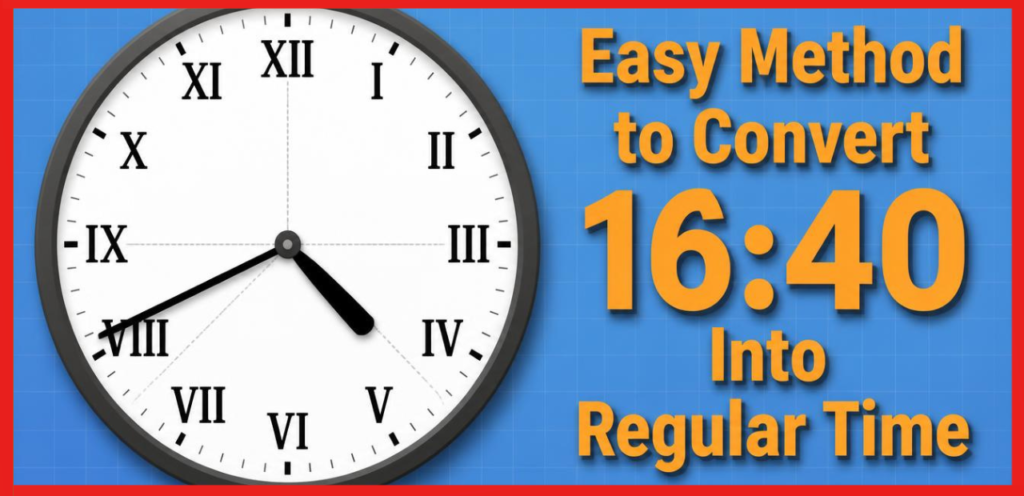
Here’s a beginner-friendly approach.
Step 1:
Is the hour greater than 12?
Yes.
Step 2:
Subtract 12.
16 − 12 = 4
Step 3:
Keep the minutes.
40 remains 40.
Step 4:
Add PM.
Final answer:
4:40 PM
After doing this a handful of times, your brain starts solving these conversions almost automatically.
Common Examples of Military Time
Learning one example often leads naturally into others.
| Military Time | Standard Time |
|---|---|
| 13:00 | 1:00 PM |
| 14:15 | 2:15 PM |
| 15:30 | 3:30 PM |
| 16:40 | 4:40 PM |
| 18:20 | 6:20 PM |
| 21:45 | 9:45 PM |
| 23:59 | 11:59 PM |
Patterns begin appearing after only a few examples.
That’s usually when everything suddenly “clicks.”
Why Businesses Prefer the 24-hour Clock
Many workplaces value precision.
Companies using Time tracking software, including tools like StaffWatcher, often display employee Work hours using the 24-hour format.
Why?
Because:
- Fewer scheduling mistakes
- Clear payroll calculations
- Better Project management
- Easier international collaboration
- Improved Scheduling
Imagine recording work like this:
09:00–16:40
There is absolutely no confusion.
Everyone reads the same thing.
16:40 Military Time in Daily Planning

If you’re trying to improve Productivity, learning military time becomes surprisingly practical.
Suppose your planner says:
- Client meeting 16:40
- Gym 18:00
- Dinner 20:00
Nothing overlaps.
Nothing requires guessing.
Many professionals use this style for:
- Daily planning
- Calendar events
- Team schedules
- Flight bookings
- Medical appointments
- Manufacturing shifts
It quietly removes tiny errors before they happen.
Funny enough, those tiny errors usually become the biggest headaches later.
Travel Stories and Time Zones
During our imaginary family vacation around Europe, we reached Brussels just before sunset.
The train ticket clearly read:
Departure: 16:40
For a second, someone asked,
“Wait…is that morning?”
Everyone laughed.
Mom smiled and replied,
“Nope. That’s 4:40 PM.”
That tiny conversation saved us from waiting twelve unnecessary hours.
Moments like these happen more often than people admit.
Fiction Makes Time Interesting Too
Imagine Batman receiving a message.
Meet me at 16:40.
In Gotham, every minute matters.
Had the note simply said “4:40” without AM or PM, things might’ve become…well, considerably messier.
Movies, comics, detective stories, and spy thrillers often prefer military notation because it feels precise.
It adds a subtle seriousness.
Even if we don’t consciously notice it.
Using 16:40 for Better Time Management

Great Time management rarely begins with expensive planners.
It begins with clarity.
Knowing exactly when something happens reduces mental clutter.
Here are a few ideas:
- Block meetings precisely.
- Reserve focus sessions.
- Track Deadlines carefully.
- Build stronger routines.
- Practice better Time tracking.
- Improve Project management.
- Protect personal evenings.
Small improvements quietly stack together.
One organized afternoon eventually becomes one organized week.
Frequently Asked Questions About What Time Is 16:40
Is 16:40 AM or PM?
It is PM.
What does 16:40 mean?
It represents 4:40 PM using the 12-hour clock.
Is 16:40 Military time?
Yes.
It follows the Military time and 24-hour clock format.
How do I convert 16:40?
Subtract 12 from the hour.
16 − 12 = 4.
The answer becomes 4:40 PM.
Is 16:40 afternoon or evening?
Most people consider 16:40 part of the Afternoon, although the transition toward evening depends on culture and season.
Fun Ways to Remember 16:40
Memory becomes easier when numbers connect to stories.
You might remember 16:40 as:
- The moment school clubs finish.
- Coffee before evening.
- Walking through Grand Place in Brussels.
- Checking into a hotel.
- Watching another Netflix episode.
- The time Megan catches her train.
- The hour Batman starts another impossible mission in Gotham.
Silly associations often become the strongest memories.
Brains are wonderfully weird like that.
Frequently Asked Question
16:40 Military Time
16:40 military time is 4:40 PM in the 12-hour clock format. It represents 40 minutes past 4 in the afternoon.
What Time Is 16:40
What time is 16:40? The answer is 4:40 PM. This is the standard 12-hour equivalent of the 24-hour time 16:40.
16:40 Time
16:40 time is read as 4:40 PM in everyday use. It is commonly used in countries and industries that follow the 24-hour clock.
1640 Time
1640 time is another way of writing 16:40 in military time. Converted to the 12-hour format, it is 4:40 PM.
16+40
16 + 40 = 56. This is a basic arithmetic calculation and is unrelated to the time 16:40, which represents 4:40 PM.
Read this blog https://alnexob.com/2230-2/
Final Thoughts
So, what time is 16:40?
The answer is wonderfully simple:
16:40 = 4:40 PM.
Whether you’re learning Military time, reading a Digital clock, planning your Work schedule, organizing Daily planning, improving Time management, managing Deadlines, or simply trying to understand a travel itinerary, this conversion quickly becomes second nature.
The 24-hour time system exists to make communication clearer, scheduling more reliable, and Timekeeping more accurate. Once you become comfortable reading it, you’ll notice it everywhere from airports and hospitals to office software, train stations, sports schedules, and international travel.
The next time you see 16:40, you won’t hesitate. You’ll know instantly that it means 4:40 PM, another ordinary afternoon made just a little easier to understand. And honestly, tiny bits of understanding like this have a funny habit of making everyday life feel a little less confusing.
