
There are certain moments when time feels strangely personal. You look at the clock, think about what you need to finish, and suddenly 55 minutes seems like both a tiny blink and a whole little lifetime.
It can be the space between sending a message and expecting a reply, the quiet stretch before a meeting, or even the time a family spends getting ready to welcome someone precious into their world.
When a baby girl arrives, for example, those ordinary minutes can become memories people talk about for years, because time has a funny way of making small moments feel enormous later on.
But sometimes you don’t need a philosophical answer. You just want to know, very simply: what time is 55 minutes from now? Maybe your appointment begins soon, your oven is running, your study session has started, or you told somebody,
“I’ll call you in about an hour,” and now you need the actual clock time. This is where a Time Calculator becomes rather handy, especially when your brain is already doing five other things at once.
If the starting time is 9:59 AM on Friday, August 28, 2026, adding 55 minutes gives you 10:54 AM. The calculation is straightforward: 9:59 AM + 1 minute reaches 10:00 AM, and the remaining 54 minutes take you to 10:54 AM. No dramatic mathematics hiding behind the curtain, thankfully.
| Current Time | 55 Minutes Added | Time 55 Minutes From Now | Day |
|---|---|---|---|
| 9:04 AM | +55 minutes | 9:59 AM | Friday |
What Time Is 55 Minutes From Now?
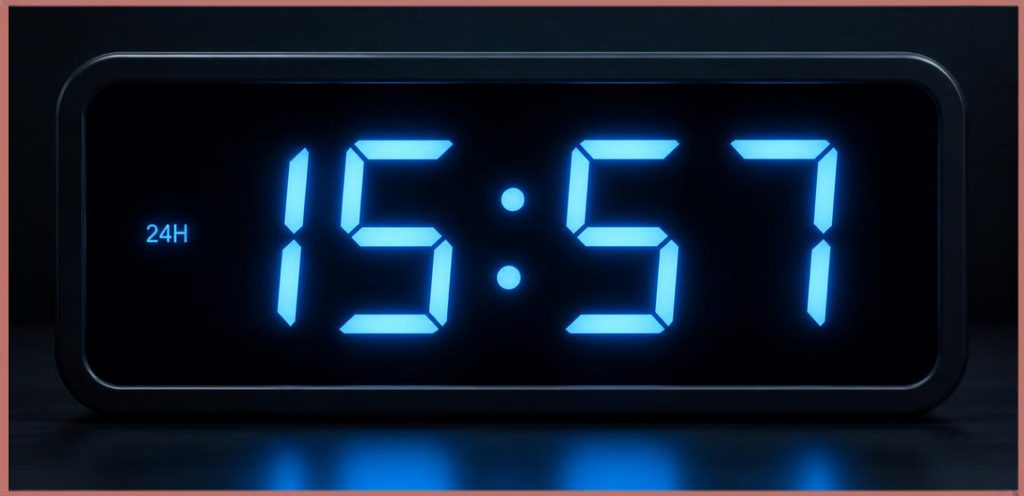
The basic idea behind 55 Minutes From Now is simply adding 55 minutes to your Current Time. You don’t actually need a complicated application for this, but an online calculator or live Clock Tool can make the process quicker when you’re in a hurry.
For example, if the current time is 9:00 AM, adding 55 minutes produces 9:55 AM. If the current time is 9:30 AM, the answer becomes 10:25 AM.
Notice what happens when the calculation crosses an hour: the hour changes, while the extra minutes continue from zero. It sounds obvious, but when you’re rushing, even obvious things can suddenly become slippery.
If the current time is 9:59 AM, as in our example, 55 minutes later is 10:54 AM. You can think of it as moving the Minute Hand forward 55 spaces on an Analog Clock, allowing the Hour Hand to move forward whenever the minute hand passes the 12.
A Digital Clock makes this even easier to see because the numbers change directly. On a Digital Display, 9:59 AM becomes 10:00 AM after one minute, then 10:01, 10:02, and so forth until 10:54 AM. Quite a small journey, really, but useful one.
55 Minutes From Now Calculator: How Does It Work?
A 55 minutes from now calculator follows a simple process. First, it identifies the current time. Next, it adds 55 minutes. Finally, it adjusts the hour whenever the added minutes cross the 60-minute boundary.
You can write the calculation like this:
Current Time + 55 minutes = Future Time
Suppose your starting point is 2:10 PM. Adding 50 minutes gives 3:00 PM, then adding the remaining 5 minutes gives 3:05 PM. So your Future Time is 3:05 PM.
The nice thing about a calculator is that you don’t have to manually think through every little step. A live Clock Interface may already know the current time,
while an interactive calculator handles the Time Calculation automatically. This can be particularly useful on a website where the reader wants a fast answer without opening a separate app.
Some tools also provide an automatic update, meaning the Current Time changes as the real clock moves. That matters because “55 minutes from now” is not a permanent answer. Five minutes later, the answer has changed too. Time is annoyingly good at doing that.
How to Add 55 Minutes to the Current Time
To add 55 minutes, start by looking at the hour and minute. Then move forward 55 minutes. If the minutes exceed 59, move into the next hour.
Here is an easy example:
Starting time: 4:20 PM
Add: 55 minutes
After 40 minutes: 5:00 PM
Remaining: 15 minutes
Final answer: 5:15 PM
Another example:
Starting time: 7:45 AM
Add: 55 minutes
After 15 minutes: 8:00 AM
Remaining: 40 minutes
Final answer: 8:40 AM
And one more, because sometimes seeing the pattern three times makes the brain go, “ohhh, right.”
Starting time: 11:35 AM
Add: 55 minutes
After 25 minutes: 12:00 PM
Remaining: 30 minutes
Final answer: 12:30 PM
This method works whether you’re using a digital time calculator, an analog clock calculator, a phone, or simply your own mental arithmetic.
Why 55 Minutes Is Almost an Hour
Fifty-five minutes is only five minutes short of an hour, which makes it an interesting length for planning. It is long enough to complete something meaningful but short enough that you can still fit it neatly into many daily routines.
A 55-minute Time Block can be used for focused work. You might spend the first few minutes organizing your thoughts, then use the bulk of the block for actual work, leaving a few minutes at the end for checking what you did. It has that “almost an hour but not quite” personality.
For students, 55 minutes can become a Study Session. Read for 40 minutes, review notes for 10, and use the last 5 minutes to write down what still doesn’t make sense. That’s often more useful than staring at a textbook for three hours while your brain quietly goes on holiday.
For readers, a 55-minute Reading block can be surprisingly satisfying. Depending on the book and reading speed, you could finish a substantial chapter. For Project Work, it gives enough room to make visible progress without making the task feel endless.
What Time Is 55 Minutes From Now for Work and Meetings?

A workday is basically a collection of small pieces of time pretending to be one large thing. A 55-minute period can fit neatly between meetings, emails, phone calls, and other interruptions.
Suppose you have a meeting at 11:00 AM and want to stop working five minutes beforehand. If you begin at 10:05 AM, you have exactly 55 minutes. Your Schedule could therefore include a focused task from 10:05 to 11:00.
This is where Time Management becomes practical rather than motivational. Instead of saying, “I’ll work on this sometime this morning,” you can create a specific Time Block with a beginning and an ending.
A simple work plan might look like this:
- 55 minutes of focused project work
- 5 minutes to save files and make notes
- 10 minutes for a Stretch Break
- Return to the next task
That little pause between blocks may actually help you feel less like you’re chasing the clock all day. Weirdly, giving time a boundary can make it feel less controlling.
Using 55 Minutes for Study, Reading, and Learning
A 55-minute study block is especially useful because it creates a clear endpoint. You know the session isn’t going to swallow your entire afternoon.
You could divide the period into smaller sections: 30 minutes learning something new, 15 minutes practicing, and 10 minutes reviewing. Or you can spend all 55 minutes on one difficult subject if that suits your brain better.
A Study Planner can use these blocks throughout the day. For example, you might schedule one 55-minute session for mathematics, another for reading, and another for writing. The goal isn’t to make every minute painfully productive. It’s to give your attention somewhere specific to go.
A Reading Schedule works in much the same way. If you begin reading at 6:15 PM, 55 minutes later it will be 7:10 PM. That gives you a simple stopping point before dinner or another activity.
If your concentration is fading badly, though, don’t treat the calculator like a boss. Take a Pause. A short Break Time can be more useful than another 20 minutes of pretending to concentrate.
What the Clock Hands Tell You About 55 Minutes
An Analog Clock gives a wonderfully physical picture of time. The Minute Hand travels around the clock face while the Hour Hand slowly follows behind it.
When you add 55 minutes, the minute hand moves almost an entire circle. Five minutes are left before it completes the full hour. That means a 55-minute calculation is visually almost one complete trip around the clock.
The Second Hand, meanwhile, keeps moving continuously. It reminds us that “now” is always changing. If you check the clock at 9:59:10, your answer will be slightly different from checking it at 9:59:50. This is why a live Clock Display is useful for exact timing.
A Clock Interface on a website may show both an analog and digital representation. The digital version is usually faster to read, while the analog version can make the passage of time easier to visualize.
What Time Is 55 Minutes From Now Compared With Other Time Periods?
Sometimes people search for several time intervals because they are comparing different planning options. The logic remains the same whether you’re asking about 5 minutes from now, 10 minutes from now, or 55.
For example, if the current time is 9:00 AM:
- 5 minutes from now = 9:05 AM
- 10 minutes from now = 9:10 AM
- 20 minutes from now = 9:20 AM
- 25 minutes from now = 9:25 AM
- 30 minutes from now = 9:30 AM
- 40 minutes from now = 9:40 AM
- 45 minutes from now = 9:45 AM
- 50 minutes from now = 9:50 AM
- 55 minutes from now = 9:55 AM
- 60 minutes from now = 10:00 AM
These examples are useful because they show how minutes from now behave without needing any complicated time conversion. Once the hour boundary is crossed, the hour simply increases.
When a 55 Minute Calculator Is More Useful Than Mental Math

For simple calculations, mental math is perfectly fine. If someone asks you what time it will be 55 minutes after 3:00 PM, you can answer 3:55 PM without reaching for anything.
But situations become less comfortable when the starting time includes unusual minutes, seconds, or AM/PM changes. Add a date change, a long schedule, or several time blocks and suddenly your confident little calculation starts looking suspicious.
An online time calculator helps reduce those mistakes. A good tool may provide an automatic time calculator, live time display, or interactive calculator that updates the answer as the starting time changes.
For websites and blogs, an embedded clock widget can also improve the User Experience. A visitor may arrive specifically looking for an answer and appreciate being able to see the Current Time, enter a duration, and receive the Future Time without leaving the page.
An Embedding Link or embedded calculator can therefore turn a simple article into a more useful Time Utility. That’s a small thing, but useful things tend to get remembered.
Using 55 Minutes for Daily Planning
Time calculations become genuinely valuable when they connect with real life. Knowing the answer to “what time is 55 minutes from now?” is only the beginning. The more interesting question is what you do with those 55 minutes.
For Daily Planning, you can use a 55-minute block for one clearly defined task. Don’t give yourself a vague assignment such as “work on everything.” Choose something concrete.
You might write:
- 9:00 9:55 AM: Project Work
- 9:55 10:05 AM: Stretch Break
- 10:05 11:00 AM: Reading
- 11:00 11:15 AM: Email
- 11:15 AM onward: Next Time Block
This approach turns a clock into a planning tool. The numbers aren’t just numbers anymore; they become little containers for attention.
It can also help with procrastination. Telling yourself “I only have to focus for 55 minutes” sounds much friendlier than “I need to finish this huge thing today.” Sometimes the brain just needs the door made slightly smaller.
55 Minutes and Personal Reminders
There are plenty of ordinary situations where knowing the exact time after 55 minutes helps.
You may have started cooking and need to check something later. You may have put laundry in the machine. You might be waiting for a delivery, preparing for a call, or giving yourself a quiet period before leaving home.
Parents can use a timer for play, homework, reading, or household routines. Students can use it for focused work. Professionals can use it for meetings and project tasks.
Families can even use a 55-minute block to prepare for a celebration, especially when the house is suddenly full of excitement and everybody is asking what needs doing next.And yes, sometimes 55 minutes is simply 55 minutes of doing absolutely nothing important. That’s allowed too.
Cultural and Everyday Meaning of Time
Different cultures can have different relationships with clocks and schedules. Some environments emphasize precise appointment times, while others allow more flexibility around social gatherings and family events. Neither approach completely captures the human experience of time.
When a new baby girl enters a family, for instance, nobody usually remembers whether the room was perfectly organized at 10:15 or whether somebody arrived seven minutes late.
They remember the tiny fingers, the sleepy face, the first photograph, the grandmother crying happy tears, the father or mother staring in disbelief.
That is one reason time calculations are useful but not everything. A clock can tell you when something happens. It cannot tell you what that moment means.For practical activities, accuracy matters. For relationships, presence often matters more.
How to Make a 55 Minute Time Block Work Better
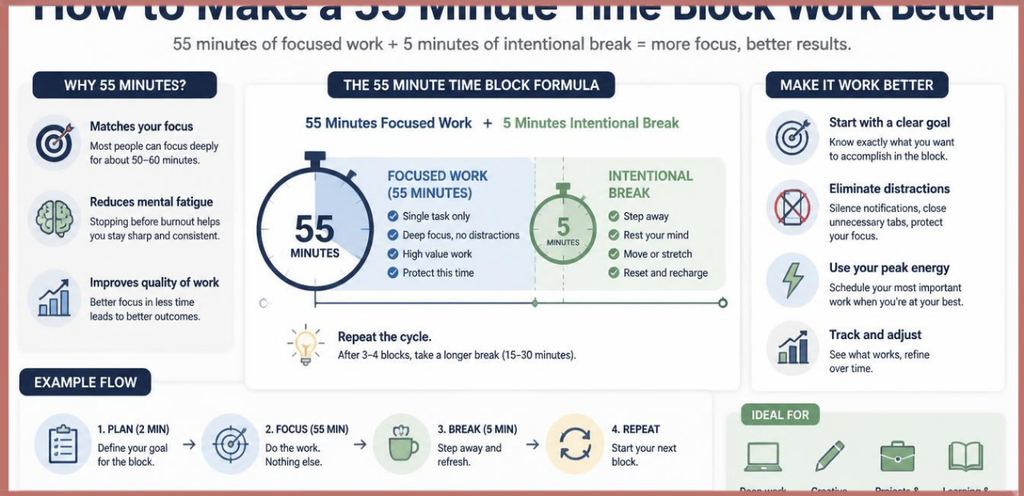
A 55-minute block works best when you decide what it is for before it begins. If you sit down and spend the first 20 minutes wondering what to do, you’ve technically used the time, but not in the way you hoped.
Choose one priority. Put unnecessary notifications away. Start your Digital Clock timer if that helps. Then work until the end of the block.
When the 55 minutes finish, give yourself a small Pause. Stand up. Stretch. Drink some water. Look away from the screen. Your eyes and brain are not decorative accessories, after all.Then decide whether you need another block.
The goal of Productivity Planning isn’t squeezing every possible second from the day. It’s using available time intentionally without making life feel like one giant stopwatch.
How to Calculate 55 Minutes From Any Starting Time
You can use this simple three-step method whenever you don’t have a 55-minute calculator available.
Step one: Write down the starting time.
Step two: Add enough minutes to reach the next hour.
Step three: Add whatever minutes remain.
For 9:59 AM:
- 9:59 AM 10:00 AM = 1 minute
- 55 1 = 54 minutes remaining
- 10:00 AM + 54 minutes = 10:54 AM
For 6:40 PM:
- 6:40 PM 7:00 PM = 20 minutes
- 55 20 = 35 minutes remaining
- 7:00 PM + 35 minutes = 7:35 PM
For 11:50 PM:
- 11:50 PM 12:00 AM = 10 minutes
- 55 10 = 45 minutes remaining
- 12:00 AM + 45 minutes = 12:45 AM the next day
That last example is where dates matter. Once midnight arrives, you aren’t merely changing the hour; you’re entering a new calendar day. A reliable Future Time Calculator should account for that automatically.
Why Accurate Time Matters
An Accurate Clock is more than a nice feature on a website. Accurate time matters for appointments, transportation, deadlines, online classes, work shifts, medication reminders, examinations, and countless small commitments.
Even a few minutes can make a difference when you’re catching a bus or joining a meeting. That’s why a Live Clock Tool can be useful when the calculation depends on the exact moment you are checking it.
A clock that updates automatically is particularly helpful because “now” moves continuously. The answer at 9:59 AM isn’t the same answer at 10:02 AM. This sounds ridiculously obvious, but it is exactly why static examples and live calculators serve different purposes.
Frequently Asked Questions About 55 Minutes From Now
What time is 55 minutes from now?
You need to know the exact Current Time first. Add 55 minutes, adjusting the hour when the minutes pass 60. For example, if it is 9:59 AM, 55 minutes later is 10:54 AM.
Is 55 minutes almost one hour?
Yes. Fifty-five minutes is exactly five minutes less than one hour. It can therefore be useful as a focused work, study, reading, or planning block.
What is 55 minutes after 9:59 AM?
It is 10:54 AM. One minute takes you to 10:00 AM, followed by another 54 minutes.
Can I use an analog clock to calculate 55 minutes?
Absolutely. Move the minute hand forward 55 minutes. The hour hand will naturally move as the minute hand passes the top of the clock.
Is a digital clock better for calculating time?
A Digital Clock is often easier for quick reading because the exact hour and minute are shown as numbers. An analog display, however, can make the movement of time easier to visualize.
Can a time calculator calculate dates too?
Many Time Calculators can handle dates as well as times. This becomes particularly useful when adding minutes crosses midnight.
Can 55 minutes be used for productivity?
Yes. A 55-minute Time Block can work well for focused project work, studying, reading, writing, planning, or other tasks, followed by a short break.
Frequently Asked Question
55 minutes from now
55 minutes from now refers to the exact time you’ll reach after adding 55 minutes to the current time, making it quick and easy to plan your next task or appointment.
what time will it be in 55 minutes
To know what time will it be in 55 minutes, simply add 55 minutes to the current clock time or use an online 55 minutes from now calculator for an instant result.
what is 55 minutes from now
What is 55 minutes from now means calculating the future time exactly 55 minutes ahead of the present moment, helping with scheduling and daily planning.
what time will it be 55 minutes from now
If you’re wondering what time will it be 55 minutes from now, a time calculator can instantly display the exact future time without any manual calculation.
1 hour 55 minutes from now
1 hour 55 minutes from now is calculated by adding one hour and fifty-five minutes to the current time, making it useful for meetings, study sessions, travel, or reminders.
Read this blog https://alnexob.com/15-weeks-from-today-2/
Final Thoughts: 55 Minutes Is Small, But Not Meaningless
So, what time is 55 minutes from now? The answer depends on the starting time, but the calculation itself is wonderfully simple: take the current clock time and move forward 55 minutes.If your starting point is 9:59 AM on Friday, August 28, 2026, the exact result is 10:54 AM.
Yet there is something oddly comforting about these little calculations. A day is built from them. Fifty-five minutes can become a completed assignment, a finished chapter, a productive work session, a long conversation, a peaceful walk, or a few quiet moments with people you love.
When a family welcomes a baby girl, time seems to change character altogether. A minute can feel impossibly long while everyone waits, then disappear instantly once the baby arrives.
Years later, nobody may remember the exact Time Display, but they’ll remember what happened during those minutes. That’s the strange bargain of time: the clock measures it equally, while our hearts do not.
Use your Clock Tool when you need precision. Use your Schedule when you need organization. Use a Time Calculator when your arithmetic is being a little stubborn.
And when you have 55 minutes with someone important, perhaps don’t spend all of them checking the clock.Sometimes the best use of future time is simply to be there when it arrives.
