
There is something strangely beautiful about waiting for a new moment. A family waiting to welcome a baby girl knows this feeling especially well the clock seems to move differently, somehow slower and faster at the same time.
One minute everyone is laughing, the next minute someone is asking, “How much longer?” Time becomes almost a character in the room, ticking quietly while a new little life is getting ready to arrive.
And honestly, that same feeling happens when we are waiting for an important call, a meeting, a flight, a deadline, or even midnight.
That is where an Hours From Now Calculator becomes surprisingly useful. Instead of staring at the clock and doing little bits of time math in your head, you can enter a number of hours and discover the exact future time quickly.
It sounds like a tiny thing, but tiny things can save us from silly mistakes. Because adding 7 hours to 8:45 PM sounds easy until your brain decides it is suddenly tomorrow.
An Hours From Now Calculator helps answer simple questions such as “what time will it be in 2 hours?” or “what time is 6 hours from now?”
It can also help when the answer crosses midnight, changes the date, or needs to be understood across different time zones. Time is simple, yes, but it has a habit of becoming complicated right when we are busy.
| Hours to Add | Time From Now | Common Use |
|---|---|---|
| 1 Hour | Current Time + 1 Hour | Quick reminders |
| 2 Hours | Current Time + 2 Hours | Meetings |
| 3 Hours | Current Time + 3 Hours | Appointments |
| 4 Hours | Current Time + 4 Hours | Study sessions |
| 5 Hours | Current Time + 5 Hours | Work planning |
| 6 Hours | Current Time + 6 Hours | Shift scheduling |
| 8 Hours | Current Time + 8 Hours | Full workday |
| 12 Hours | Current Time + 12 Hours | Day/Night planning |
| 24 Hours | Current Time + 24 Hours | Next day scheduling |
| 48 Hours | Current Time + 48 Hours | Two-day planning |
Hour Conversion Reference
| Hours | Minutes | Seconds |
|---|---|---|
| 1 | 60 | 3,600 |
| 2 | 120 | 7,200 |
| 3 | 180 | 10,800 |
| 6 | 360 | 21,600 |
| 12 | 720 | 43,200 |
| 24 | 1,440 | 86,400 |
| 48 | 2,880 | 172,800 |
| 72 | 4,320 | 259,200 |
| 168 (1 Week) | 10,080 | 604,800 |
What Is an Hours From Now Calculator?

An Hours From Now Calculator is an online Time Calculator designed to calculate a future time from a given starting time. Usually, you enter the number of hours you want to add, and the calculator returns the resulting ending time. Some tools also include Minutes and Seconds, making the calculation more precise.
For example, if your current time is 3:00 PM and you add 4 hours, the answer is 7:00 PM. Nothing dramatic there. But if you add 12 hours to 8:30 PM, the result becomes 8:30 AM the next day, and that “next day” part is where people sometimes forget it.
The basic idea is simply time addition. The calculator takes your starting point and moves forward by the selected time duration. It is basically a little digital clock that does the boring arithmetic while you get on with your day, which is a fair trade I think.
An Online Hours Calculator can be useful for personal schedules, work shifts, reminders, travel plans, study sessions, appointments, and countless other situations. It can also act as an hours ahead calculator when you want to know exactly when something will happen later.
How the Hours From Now Calculator Works
The underlying time calculation is not mysterious. One Hour contains 60 minutes, and one hour contains 3600 seconds. Once you know this, adding hours is simply a matter of moving forward through the clock and adjusting the Date when necessary.
For instance, adding 3 hours to 10:00 AM gives 1:00 PM. Add another 3 hours and you get 4:00 PM. If you continue adding hours, eventually the clock passes midnight, and then the calculator must change the date too.
This is where a proper future time calculator is much less annoying than mental arithmetic.
A useful basic relationship is:
1 Hour = 60 Minutes = 3600 Second
There are also 168 hours in one Week, because 7 days contain 24 hours each. So if someone asks you to calculate a time 168 hours from now, they are effectively asking you to move exactly one week forward, assuming there are no special calendar complications involved.
This is also why an Add Hours Calculator is different from simply looking at a clock. A clock tells you where you are. A calculator tells you where you are going. Slightly philosophical for a calculator, maybe, but true.
Why People Use an Hours From Now Calculator
The most obvious reason is convenience. People regularly need to calculate hours from now when they are planning something that happens later in the day or even several days ahead. Doing it manually is possible, but using a calculator is faster and usually less error-prone.
Imagine you have a medication reminder, an online class, a work deadline, or a scheduled call. You know it needs to happen 5 hours later, but the current time is awkward, perhaps 9:47 PM. You can calculate it yourself, of course. Or you can let an instant time calculator do it in a second.
Another reason is that people don’t always notice date changes. “10 hours from 6 PM” is not 4 PM today; it is 4 AM tomorrow. The calculator makes the calendar transition visible, which is useful when date and time calculations actually matter.
It is also helpful for time planning. When several tasks are stacked together, even a small calculation mistake can push everything out of place. A simple time planning tool gives you a clean starting point.
Hours From Now Calculator for Everyday Questions
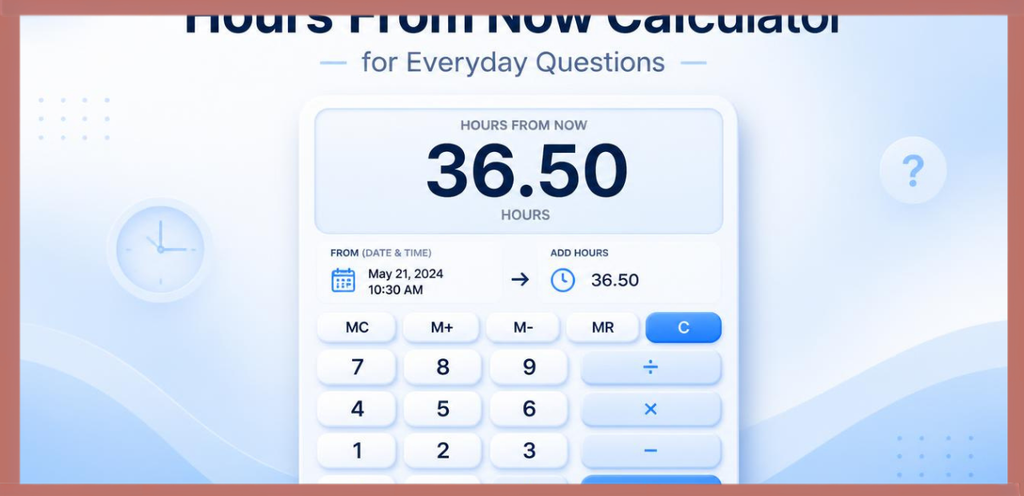
People search for very ordinary things when they need a quick answer. They might type 30 Minutes From Now, 1 Hour From Now, or “what time will it be in 3 hours?” These questions look almost too easy, but there is no prize for doing easy arithmetic badly.
Here are common examples where an hours calculator can help:
- 30 Minutes From Now can be useful when you need to know exactly when a short break, appointment, or reminder ends, especially when the current minutes are awkward.
- 1 Hour From Now is helpful for quick reminders, cooking times, study sessions, and short appointments.
- “What time will it be in 2 hours?” is a common question when planning a simple activity later in the day.
- “What time will it be in 3 hours?” becomes useful for work meetings, online classes, and travel.
- “What time is 5 hours from now?” can help with long study blocks, work shifts, and event planning.
- “What time is 6 hours from now?” is often useful when planning overnight schedules or international communication.
- “What time is 12 hours from now?” helps identify the corresponding morning or evening time on the following day.
- Add 24 hours to current time is especially straightforward because the clock time generally stays the same while the date moves forward by one day.
These examples show why an online time calculator is not really about difficult mathematics. It is about removing little pieces of friction from daily life.
Hours From Now Calculator and Date Changes
One of the most important details in any Hours From Now Calculator is the date. A time calculation can cross midnight, and when that happens, the result belongs to the next calendar day.
Suppose your starting time is Sunday at 10:00 PM. Add 5 hours. You pass midnight after 2 hours, then continue for another 3 hours.
The answer is Monday at 3:00 AM. If you only calculate the clock portion, you might write 3:00 AM and forget that the day has changed. That tiny omission can cause a surprisingly large problem for travel or appointment planning.
This is why an hours to date calculator or broader date calculator can be valuable when calculations extend beyond a single day. The time and date are connected, even though we often treat them like separate things.
For longer calculations, a future date calculator can make the answer easier to understand. Instead of giving you only a clock time, it shows when that time occurs on the calendar.
Hours From Now Calculator Across Time Zones
Things get more interesting when other countries enter the picture. A meeting that is 3 hours from now for you is still 3 hours from now for someone elsewhere, but the displayed clock time can be completely different.
This happens because of Time zones and the Time zone offset between locations. For example, Eastern Time (ET) and Pacific Time (PT) are separated by three hours in the United States under the usual standard relationship, although daylight-saving rules affect the exact UTC offsets during parts of the year.
A person arranging a call between New York and Los Angeles needs to think about local time rather than simply adding hours to one clock. Someone might say, “Let’s talk at 3 PM,” while another person is thinking about their own 3 PM. Suddenly the meeting exists in two different universes.
For scheduling across time zones, a Time Zone Calculator or Time Converter is more appropriate than a basic hours calculator.
These tools can account for the relevant local times and time offset. This is especially useful for remote teams, international customers, online events, and family members living in different countries.
Manual Time Calculation: The Simple Method
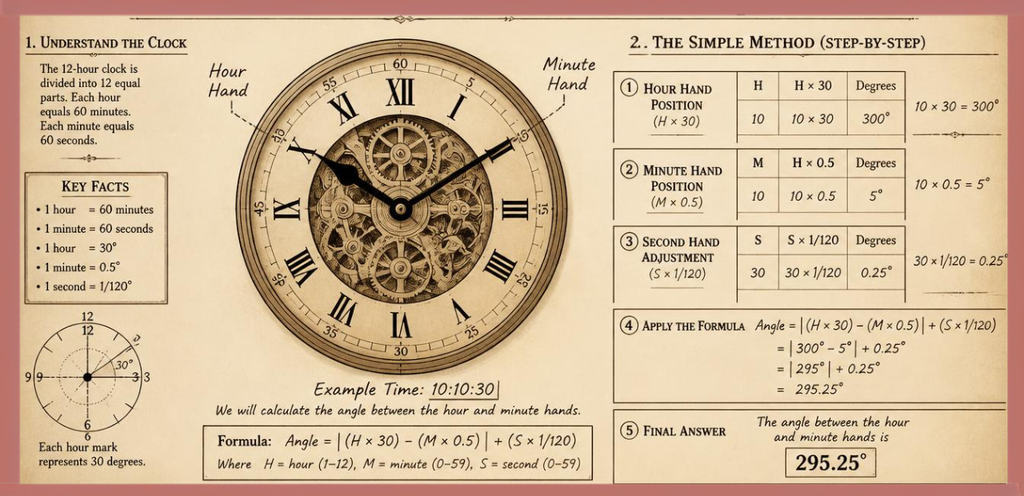
You do not always need a digital calculator. Knowing manual time calculation is useful because it helps you understand what the tool is actually doing.
Start with the starting time and add the requested hours one at a time. If you reach 60 minutes while working with minutes, convert them into one hour. If you pass 12:00 AM, move to the next date. It is basic time arithmetic, but writing it down makes the process less confusing.
For example, imagine the starting time is 7:30 PM and you want to add 8 hours.
7:30 PM + 4 hours = 11:30 PM.
Another 30 minutes takes you to midnight, and the remaining 3 hours and 30 minutes bring you to 3:30 AM.
So the answer is 3:30 AM the following day. See, the clock did not really do anything strange. Our human brain just likes making midnight feel like a cliff edge.
The formula can be thought of simply as:
Future Time = Starting Time + Time Duration
For calculations involving dates, the result also needs to include the appropriate calendar day. That’s the bit that manual time calculation sometimes misses.
Hours From Now Calculator for Meetings and Calls
Modern schedules are packed with little commitments. A Meeting schedule might contain several appointments, while Call scheduling may involve people who are not even in the same country.
Suppose you finish work at 5:00 PM and want to call someone 4 hours later. An Hours From Now Calculator can quickly tell you that the call time is 9:00 PM. If the other person lives in another time zone, you can then use a Time Converter to understand their local time.
This two-step approach is useful for business scheduling, appointment scheduling, and international communication. It prevents the classic message: “I thought you meant my time.” Almost every remote worker has probably met that sentence at least once.
A meeting time calculator can also help when several people need to coordinate. For bigger teams, dedicated scheduling software may be better, but for a simple “how many hours from now?” question, a calculator is perfectly practical.
Hours From Now Calculator for Work and Productivity
Work schedules often involve elapsed hours rather than ordinary clock times. A Total Work Hours Calculator can be useful for determining how long a shift lasts, while an Hours From Now Calculator helps determine when the shift or task will end.
Imagine starting a task at 9:15 AM and planning to work for 7 hours. The ending time is 4:15 PM, assuming no break needs to be deducted. If you include a 30-minute lunch break, however, the schedule changes. This shows the difference between time duration and actual scheduled clock time.
For productivity, knowing the exact end of a work block can also create a little psychological boundary. Instead of saying “I will work for a while,” you can say, “I will work until 2:40 PM.” Oddly enough, the second statement feels much more real.
This is where related tools such as a Work Hours Calculator, time duration calculator, and time tracking tools can work together. Each solves a slightly different problem, rather than one calculator trying to become the entire universe.
Hours From Now Calculator vs. Other Time Calculators

There are many Time Calculators, and their names can sound similar even though their jobs are different.An Add Hours Calculator is designed to add hours to a starting time.
A Time Difference Calculator usually determines how much time exists between two points. A Time Converter changes a measurement or time representation, such as converting hours into minutes.
An Add Days Calculator works with calendar days, while a Total Work Hours Calculator focuses more on working periods. A Time Zone Calculator handles differences between locations.
Understanding these differences makes it easier to choose the correct tool:
- Hours From Now Calculator calculates a future clock time from now or another starting point.
- Add Hours Calculator adds a chosen number of hours to a specified time.
- Time Difference Calculator finds the duration between two times.
- Time Converter converts between time units or formats.
- Add Days Calculator moves a date forward or backward by days.
- Total Work Hours Calculator helps calculate working duration.
- Time Zone Calculator compares or converts times between locations.
The tools overlap a little, but not enough to make them identical. It is like having different keys on a keyring; they all look small, but only one opens the door you actually need.
Understanding Hours, Minutes, and Seconds
The foundation of everyday Time measurement is wonderfully consistent. One hour has 60 minutes, and one minute has 60 seconds. Therefore, one hour contains 3600 seconds.
These conversions become handy when precision matters. For example:
2 hours = 120 minutes = 7200 seconds
Similarly:
5 hours = 300 minutes = 18,000 seconds
If you’re building an embedded calculator or website widget, these relationships are important because the calculator needs to convert values accurately before displaying the result.
For ordinary users, however, the most important lesson is simpler: if your calculation contains minutes and seconds, do not casually round them unless the situation allows it.
A few minutes may not matter when planning dinner, but they matter quite a lot when catching a flight or joining an important online meeting.
Common Mistakes When Calculating Hours From Now
One common mistake is forgetting AM and PM. Adding 5 hours to 9 PM does not produce 2 PM on the same day. It produces 2 AM the following day. This seems obvious when written out, but tired brains are talented little creatures.
Another mistake is forgetting the date transition. If the calculation passes midnight, the future time belongs to another date. A reliable calculator displays that change instead of leaving you to guess.
Time zones create another issue. If you are calculating a meeting between two locations, you should not assume that both clocks use the same offset throughout the year. Daylight-saving changes can affect certain regions, so international time scheduling deserves extra attention.
People also sometimes confuse elapsed time with clock time. Eight hours after 4 PM is midnight, but eight hours of working time with a one-hour break could produce a different ending time. The distinction is small but important.
How to Make Time Calculations More Personal and Useful

A calculator gives you an answer, but the way you use that answer can be much more thoughtful. If you are planning a family event, for instance, do not merely write down the time. Add the date, location, expected duration, and any time-zone details that other people need.
For a birthday, meeting, appointment, or celebration, you might write: “The event begins 6 hours from the current time, at 2:30 AM tomorrow,” rather than simply saying “2:30.” The extra information may look slightly excessive, but nobody has to ask, “Which day?”
When communicating internationally, include the recipient’s local time. A message such as “Our call is at 10 AM ET, which is 7 AM PT” is much clearer than simply writing “10 AM.” Good scheduling is partly mathematics and partly kindness.
Practical Ways to Use an Hours From Now Calculator
An Hours From Now Calculator can quietly support many parts of everyday life. Students can use it to plan study sessions. Workers can estimate shift endings. Parents can schedule activities.
Travelers can calculate future checkpoints. Businesses can coordinate calls. Friends can figure out when an event begins without opening a dozen apps.
It can also be used for:
- Time planning for personal routines and daily tasks.
- Event planning when activities have fixed durations.
- Appointment scheduling when you need an exact future clock time.
- Business time calculator tasks involving deadlines and meetings.
- Time tracking when monitoring how long an activity continues.
- Calculating hours later for reminders or scheduled tasks.
- Checking an exact future time before sending an important message.
- Comparing local and international times for remote communication.
- Estimating remaining time before a planned activity.
- Performing quick date and time calculations without manual arithmetic.
The real benefit is not that the calculator knows something humans cannot know. We can all add hours. The benefit is that it performs the boring part instantly and consistently, leaving your attention available for things that actually deserve it.
A Small Example: Planning a Day
Imagine you wake at 7:00 AM and want to structure your day. You plan breakfast for 1 hour, study for 3 hours, take a 30-minute break, work for 5 hours, and attend an evening event.
A simple Time Calculator can help you map each block. The study session ends at 10:00 AM, the break ends at 10:30 AM, and five hours of work would take you to 3:30 PM if there are no additional breaks. Suddenly the day has shape.
This is where time management becomes practical rather than motivational. You are not merely telling yourself to “use time wisely.” You are giving your time actual addresses on the clock. Strange little thing, but it works.
Why Accuracy Matters With Future Time

A small error in a casual plan may not matter. But in professional or personal situations, accuracy can become important very quickly. A missed appointment, incorrect deadline, or badly converted international meeting can cause unnecessary stress.
A good accurate time calculator should clearly identify the starting point, amount of time added, and resulting date and clock time. It should handle minutes, seconds, and midnight transitions properly.
For international scheduling, always verify the relevant time zone offset and whether daylight-saving changes apply. The calculator can do much of the arithmetic, but the person making the appointment still needs to confirm that the selected location is correct.
Technology can calculate beautifully. It cannot always rescue a badly entered location.
Frequently Asked Question
168 hours from now
168 hours from now is exactly 7 days from the current time. Simply add seven full days while keeping the same hour and minute.
what is 2 hours from now
2 hours from now is the time exactly 120 minutes after the current moment. It keeps the same minutes, only the hour changes.
100 hours from now
100 hours from now equals 4 days and 4 hours from the present time. An hours-from-now calculator gives the exact date and time instantly.
what is 7 hours from now
7 hours from now is the exact time 7 hours after the current moment. It automatically accounts for crossing midnight if needed.
when is 48 hours from now
48 hours from now is exactly 2 days from the current date and time. The hour and minute remain the same after adding two full days.
Read this blog https://alnexob.com/6-hours-from-now-is-what-time/
Final Thoughts on the Hours From Now Calculator
Time is one of those things we rarely notice until we suddenly need to know exactly where it is going. A newborn baby girl arriving into a family can make every minute feel meaningful; an important deadline can make every minute feel expensive. Somewhere between those two extremes, everyday life keeps moving quietly forward.
The Hours From Now Calculator gives us a simple way to understand that movement. Whether you need to add hours from now, calculate hours ahead, determine what time will it be, or plan a meeting across time zones, the basic idea remains wonderfully practical.
Use an Add Hours Calculator when you need to move forward from a known time. Use a Time Difference Calculator when you need to measure the distance between two moments.
Use a Time Zone Calculator when geography enters the conversation. And when your question is simply “what happens several hours from now?”, an Hours From Now Calculator is probably the cleanest answer.
The best part is that these calculations can turn vague plans into clear moments. “Later” becomes 9:30 PM. “Tomorrow morning” becomes 7:15 AM. “In six hours” becomes an exact point on the calendar.
And perhaps that is the quiet usefulness of time calculators: they do not make time slower, faster, kinder, or longer. They simply help us see it clearly.
So whether you are waiting for a celebration, preparing for a meeting, welcoming a daughter, finishing your work, or just wondering what the clock will say a few hours from now, knowing the answer can make the next step feel a little easier.
If you have a favorite way of using an Online Hours Calculator, or a funny story about getting a time calculation completely wrong, share it with others.
Sometimes the smallest clock mistakes make the best stories and thankfully, they are much easier to laugh about once the appointment has already happened.
